Hybrid Quantum Neural Networks for Image Classification
Project Overview
As we reach limits with classical compute power, it becomes necessary
to investigate methods that execute faster and are capable of solving
more difficult problems. By applying concepts from quantum mechanics to
the computing space, we can leverage the power of superposition, entanglement,
and interference to parallelize operations and operate at higher dimensions.
In this project, we compare classical machine learning with quantum machine learning
through image-based car model classification algorithms. Specifically, our models predict
vehicle make, model and year. This problem being chosen because it's already sufficiently
difficult for a classic approach using convolutional neural networks due to the minute level
of detail a model would need to extract to differentiate between model years. Our goal with this
project is to determine whether quantum-enhanced models can achieve performance comparable to
or superior to classical approaches in the context of image classification.
We explored two separate approaches:
A smaller-scale experiment comparing a classical CNN against a hybrid quantum model using
a quanvolutional preprocessing layer.
A larger-scale experiment using a ResNet-50 backbone combined with a variational quantum
circuit head training on a combined Stanford Cars and VMMRdb dataset
Datasets
Stanford Cars Dataset
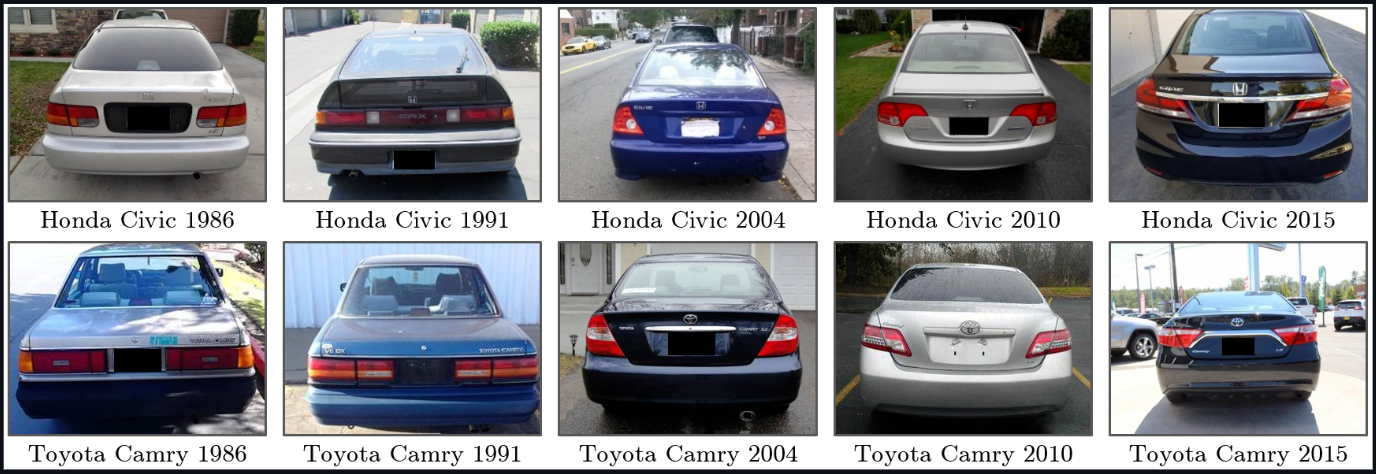
The Stanford Cars dataset contains 16,185 images across 196 vehicle classes. Each class generally
represents a specific vehicle make, model and year combination.
VMMRdb Dataset
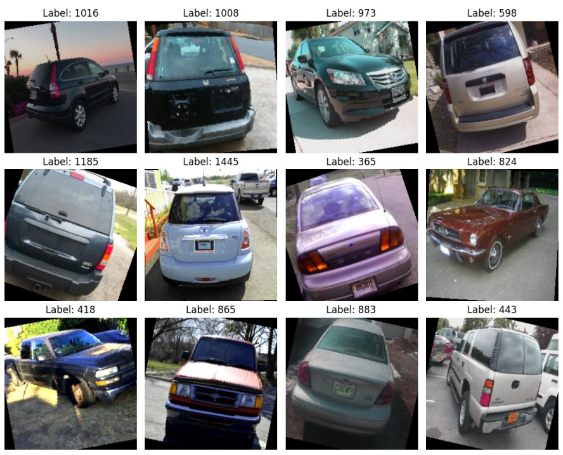
The vehicle Make and Model Recognition Database (VMMRdb) contains 291,752 images across 9,170 classes.
The dataset includes variation in lighting conditions, image quality, and camera angle. Though
generally the same angles are used across classes.
Dataset Processing
This normalization was done solely on the larger-scale normalization. The smaller-scale explored 3-10 classes
in the Stanford Cars dataset, so this normalization wasn't necessary.
Normalized class labels across both datasets.
Removed trim, body style and other identifiers that weren't considered make, or model in order to align overlapping
classes
Filtered out classes with fewer than 40 images
Limited each class to a maximum of 100 images per dataset to reduce imbalance.
Our final combined dataset contained 2023 classes
Data Augmentation
This was generally identical across both experiments. We even explored the impact of RGB channel normalization in the small experiment.
All of this augmentation was in an effort to decrease the chance of overfitting, improve convergence, and create a more robust dataset.
Resized images to 224 x 224
Added random horizontal flips
Added random color jitter
Added random rotation
Added RGB channel normalization
Quanvolutional Layer Architecture
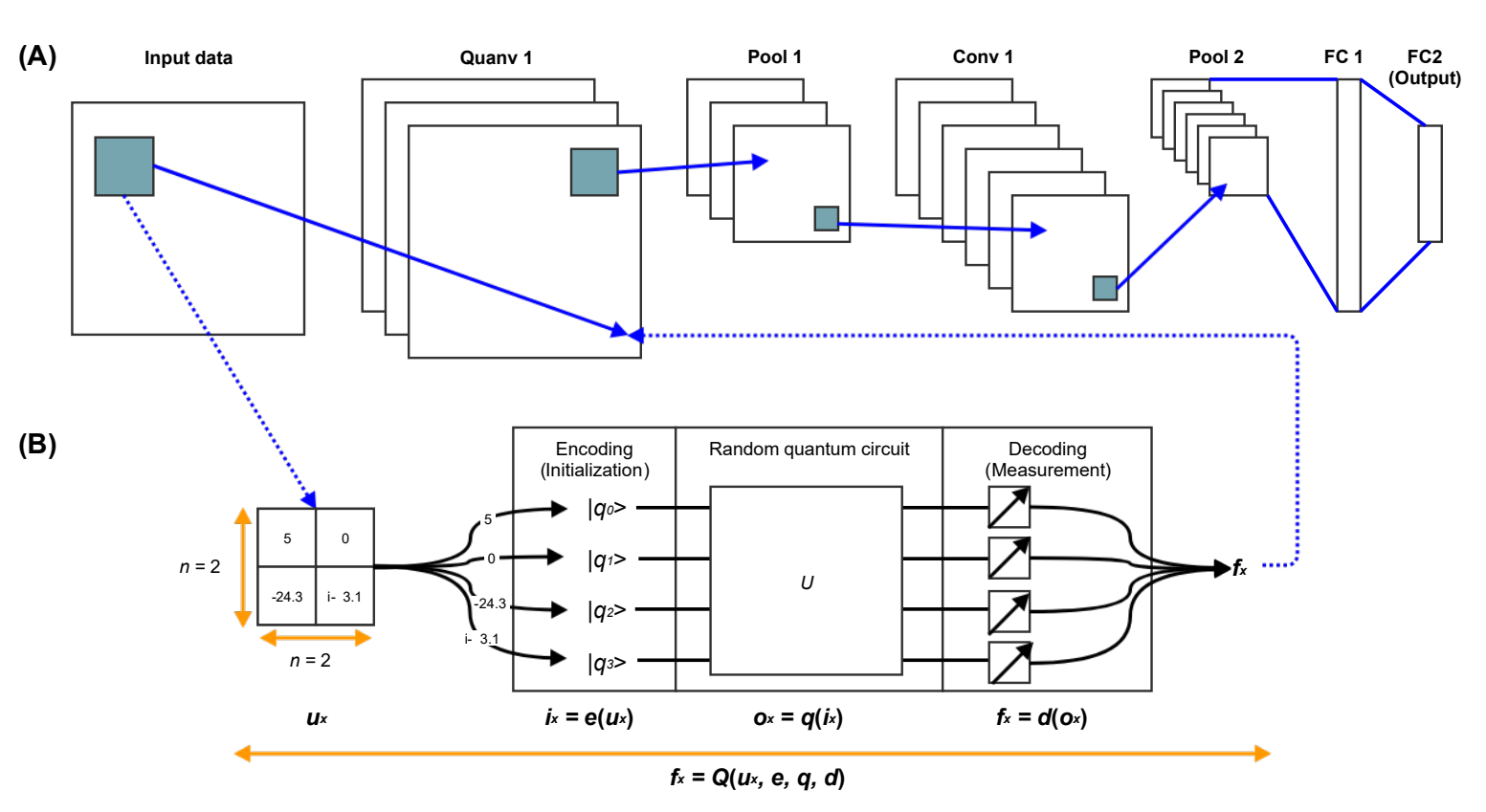
The operation of the quanvolutional layer follows a pipeline similar to that of a classical convolution.
A small subsection of the image, denoted as ux, is first selected from the input image.
This local subsection may be, for example, a 2×2 or 3×3 patch of pixels. The values in this patch are then encoded into a quantum state through an encoding
function e, producing an initialized quantum state ix = e(ux). After encoding, the quantum state is processed by a quantum
circuit q, producing an output quantum state ox = q(ix). Finally, the information contained in this output quantum state is decoded
back into a classical scalar value through a decoding function d, yielding the final quanvolutional feature value fx = d(ox).
This transformation can be summarized as fx = Q(ux, e, q, d), where Q represents the full quanvolutional filter transformation.
Conceptually, the quanvolutional layer attempts to use the high-dimensional structure of quantum mechanics to generate feature transformations that may be difficult to reproduce
classically. In the same way that classical convolutional filters detect local image patterns, the quantum circuits act as feature detectors operating on local image regions.
However, instead of simple matrix multiplications and additions, the local data undergoes a quantum evolution through entangling gate operations and quantum superposition.
In our implementation, we specifically use random quantum circuits for these transformations in order to establish a baseline implementation of the architecture. An important aspect of the
quanvolutional approach is that the quantum circuits operate only on small local regions of the image rather than on the entire image at once. This design choice significantly reduces
the required quantum resources. Because each local patch contains only a small number of pixels, only a small number of qubits are needed per quantum filter.
This makes the approach potentially suitable for noisy intermediate-scale quantum (NISQ) hardware, since the circuits can remain relatively shallow and require little or no error correction.
Combined Dataset Architecture
Classical Baseline ResNet-50 Model
We used a ResNet-50 convolutional neural network as the classical baseline.
At their core, ResNet architectures utilize residual connections to improve gradient
flow, which enables deeper networks while mitigating the vanishing gradient problem.
To improve computational efficiency, ResNet models also use bottleneck blocks that
intentionally reduce channel dimensionality before doing to bulk of the convolution computation.
Hybrid Quantum Neural Network (HQNN)
Our hybrid architecture combines a pretrained ResNet-50 backbone with a
variational quantum circuit implemented using PennyLane. The ResNet-50 acts
as a feature extractor, producing a 2048-dimensional feature vector that
is then projected down to the number of qubits our circuit uses. That number
being 6 in our case. Those 6 features are then encoded into the quantum circuit through
parameterized rotation gates and then mapped back into the classical feature space to
produce the final classification outputs.
Results
Combined Dataset
ResNet-50 Top-1 Accuracy
35.78%
ResNet-50 Top-5 Accuracy
65.50%
HQNN Top-1 Accuracy
0.21%
HQNN Top-5 Accuracy
0.81%
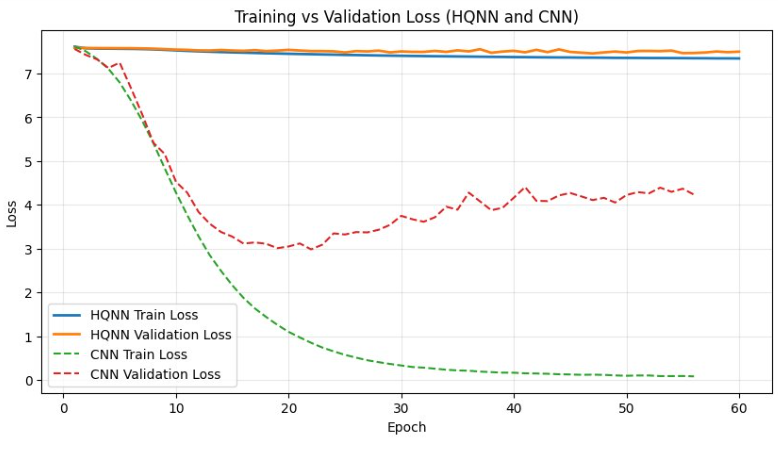
The classical ResNet-50 model significantly outperformed the hybrid HQNN on the large-scale dataset. Fine-tuninng of a
pretrained ResNet-50 model with our quantum circuit head was tried with minimal gain, only a 0.41% improvement above an
HQNN model not using fine-tuning. Overall, the projection from a 2048 feature space down to a 6 dimentional feature space is
likely the cause of this drop in performance. In our future work we consider some ideas of how to potentially improve this.
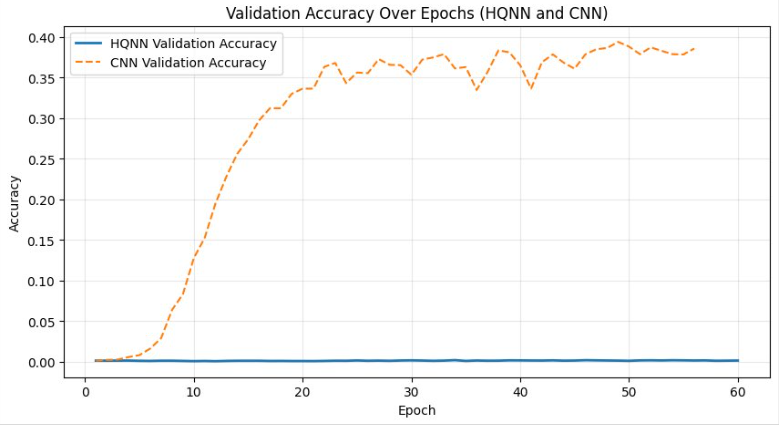
The validation accuracy, validation loss, and training loss remains constant while training the HQNN, not improving much at all. The validation accuracy, validation
loss and training loss for the CNN/ResNet-50 model do improve for around 20 epochs before the model actually begins to overfit as shown by the increase
in validation loss and the jitteriness of the validation accuracy after that point.
Subset Results
With the simulation for a QNN on a small subset of data, it was evident that adding the quanvolutional layer had noticeable improvements over a solely classical implementation.
However, this was only tested for a very specific case -- the case of having an insanely small dataset. While we did test on a larger dataset and see that
the hybrid model was actually hurting performance, there is still room to investigate this, as the HQNN used with the combined dataset was not based on the same
implementation as the small-scale model, i.e. the two models had different architectures. We initially didn't think this would have an impact because we
thought that just the concept of adding a quantum circuit to a neural network would improve performance, but after firsthand experience
tweaking the model construction and layers, it is clear that overall performance depends on a variety of factors, architecture included.
Future Work
Adding quanvolutional layers into the larger ResNet-based model instead of using a VQC head.
Using larger quantum circuits with more qubits
Investigating a multi-headed quantum circuit approach
Using a more robust backbone, like a ResNet-152 model